Mostrando entradas con la etiqueta 1984. Mostrar todas las entradas

viernes, 11 de diciembre de 2015

We are the Big Norse Brothers of Fire, are we not?

It is widely known that 1984 made accurate predictions of society in many respects, being mentioned most often the manipulation of information or constant surveillance, but have you ever stopped to think what happened to the identity of humans or how humans are manipulated to unconsciously dispose of their identity?

The point where I am trying to get is that in fictional dystopian societies, a ruling entity does whatever necessary to destroy the freedom of individual thought, for the sake of their own purposes and ideals. Do you not think that is similar to what happens today not only in our country, but all around the world in various ways?

Nowadays, techonology has allowed us to become connected to everyone wherever we are, almost without limitations. Security innovations now give us the possibility of controlling security cameras with our phones to prevent criminals from entering our houses. We can instantly contact people from all over the world not only via written means, but also with video. We can share pictures, videos, moments with anyone we want, almost without any restriction.

As time passes,computers, cameras and phones become more and more sophisticated and more powerful, to the point where we can even use only our phones to do almost all our work:  Write and edit text documents, calculations, spreadsheets, slideshows, edit photographs and videos, or develop any framework we can come up with and that can help us get the job done.

But there are some drawbacks, and here I will try to approach my main point. More and more people are becoming accustomed to over-sharing. Few things are left only for ourselves and our close relatives to enjoy. We keep showing the world anything that happens to us: all our trips, all our achievements, what happens to us on a day-to-day basis, and all the things we buy or are given, just for people to see, without really knowing or controlling who sees what. We just want to feel the recognition of our peers, but we are doing it the wrong way. And some can take unfair advantage of this. Anyone can make use of our pictures, our videos, with any purpose in mind.

Do you see now where I am going? In the novel, the Party monitors the people of Oceania 24 hours a day and 7 days a week. There is complete control over what the population does thanks to microphones and the infamous Telescreens:
The telescreen recieved and transmitted simultaneously. Any sound Winston made, above the level of a very low whisper, would be picked up by it; moreover, so long as he remained within the field of vision which the metal plaque commanded, he could be seen as well as heard. There was of course no way of knowing whether you were being watched at any given moment. How often, or on what system, the Thought Police plugged in on any individual wire was guesswork. It was even conceivable that they watched everybody all the time. But at any rate they could plug in your wire whenever the wanted to. You had to live- did live, from habit that became instinct- in the assumption that every sound you made was overheard, and, except in darkness, every movement scrutinized. (Orwell, 1949)
We know for a fact that different organizations and corporations are keeping track of all our movements and all we do, thanks to our beloved internet. And those archives with personal information will just not stop growing: we keep subscribing to sites and purchasing services online, while we give away important information including ID numbers or bank account information. The amount of data has not stopped increasing since the technologies became accessible to anyone.


And the problem extends even further when we consider our "need for speed". We have forgotten patience and we always want things to arrive right now, the services have to be provided right now. And without exception, unless, of course, I pay more than the person next to me. We are selfish and, in our selfishness, we are no different from anyone else. The vast majority of people alter their internet profiles to look flawless, to appear perfect and be praised for it.
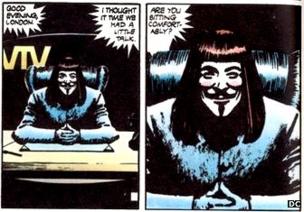
Even though discrimination is slowly decreasing, it usually happens that if you even dare to express yourself online and your opinion differs from the mass's, then you are lapidated and put to shame with no real excuse, just for thinking differently. Do you not think this is similar to the Psychological Manipulation in V for Vendetta or 1984?


What does the future hold for us? Hopefully a better education will make all of us aware that there will be consequences for our actions, both online and in real life, regardless of what we believe in, or what our goal in life is.

Reference:

Orwell, G. (1954) 1984. London: Penguin


a fight against the system


“Bartleby the scrivener” by Herman Melville (1953) , and 1984 by George Orwell (1949) are two well known classics that, even though,  written 100 years apart from each other, placed in different countries and continents, and showing totally different scenarios , share some characteristics of society, such as  inequality, social isolation, and social and individual roles in a system that wants to control everything. These characteristics  can be analyzed and compared to reach a conclusion about the main concerns of the authors in a dystopian world, in which everything is imperfect and everything goes terribly wrong.
By means of this, I will start by giving a little summary of both stories as to contextualize the information that will be compared ahead. Secondly,  I will give the historical context of both stories to show how the development of those events could have lead the authors to produce such important pieces of work. Thirdly, I will compare the information gathered to reach conclusion.


First of all, “Bartleby the scrivener” tells the story of an unambitious Wall Street lawyer that decides to hire a fourth clerk to relieve the load of work of his law firm.  A man called Bartleby takes the job and after days of successful and dutiful job, decides not to work anymore, refusing any duty with the words “I would prefer not to”. However, he also refuses to quit his job, to be fired, and to leave the workplace, turning into an unwanted and eccentric guest.


1984 is a dystopian novel that takes place in a post-apocalyptic Era in which  the Earth has been divided among 3 nations which are constantly on war with each other. The novel  follows the story  of a man  named Winston who lives in London in the nation of Oceania. He is a low-ranking member of the ruling Party leadered by a political figure known only as Big Brother, and feels frustrated by the oppression and rigid control of the Party. These nations, more especially Oceania, is characterized by its power for  controlling everything that their citizens do, for the use of propaganda to brainwash their citizens, for the use of devices to oppress their populations,  the criminalization of thoughts, and for the invention and implementation of a  language, called Newspeak, that aims to prevent future rebellions.


Secondly,  In his essay about modernism Childs (2000) explains that Modernist texts often focus on social, spiritual or personal collapse, all of these characteristics are present in these dystopian stories, and showcase their plot since they are set in  a time when social relations are almost lost because of the capitalist, and totalitarianism voragine. “Bartleby the scrivener” was written in an era in which the world was being reshaped by means of countless important historical events that happened only a few years before and after its publication. Namely, the Industrial revolutions in Europe, which created an economic gap in the world economy that has been impossible to close until today,  the rise of some colonies against the empires because they didn’t want to be ruled by them anymore, the 1840 to 1850 labour riots because of class warfare in New York, and the worldwide spread of capitalism among others events.


On the other hand, 1984 was written in a time in which society was facing the beginning of the Cold War, a time in which the world was absolutely polarized, people didn’t trust on each other,  and  some countries were really impoverished after the end of the World War II. Some countries enjoyed their freedom while others were tyrannized under totalitarian regimes that kept and iron fist on its citizens, who had little or no freedom, and that were forced to work, were poor, hungry, and living under the constant menace of mass execution, an allegedly common procedure in those regimes.


Both stories highlight the conditions in which the working class lived in those times.  The working class was so impoverished after all the global events that had happened, not to mention because the minimal wage didn’t exist yet,  that they worked not to live, but to survive. Meanwhile, the upper class enjoyed their extravagant luxuries and lifestyle, something that we can also relate with to today’s society. The following quote of Bartleby the scrivener mentions how Turkey, one of the scriveners wasn’t able to even afford new clothes, even though, he worked on a law firm.


The truth was, I suppose, that a man of so small an income, could not afford to sport such a lustrous face and a lustrous coat at one and the same time. As Nippers once observed, Turkey’s money went chiefly for red ink. (Melville, 2003:4)


Therefore, office workers like Bartleby, Nuts, Turkey, and Nippers had to  live in practical poverty because people in the position of authority, in this case their boss, the lawyer, didn’t take into account to real needs of his workers. Moreover, 1984 also mentions the impoverished look and aesthetics of the working class.


He moved over to the window: a smallish, frail
       figure, the meagerness of his body merely emphasized by the blue
         overalls (Melville, 2003:2)


Their society presents a dichotomy in their living conditions. The head of the Party, the Inner party, lived with luxury, with servants at their disposition, and in beautiful apartments, while the the Party members, who were the majority,  lived in single room apartments located in rickety places. Even their food was tasteless and of low quality. These dreary, decrepit and dark scenes of poverty are a fine example of dystopia in both stories.


Another comparison between the two books is that it is full with class alienation, and the social roles of the characters are uneven. In “Bartleby the scrivener” the lawyer separate himself physically  from his workers by putting screens to divide his space and their space, that way he didn’t need to look at them while they worked, yet, this simple act of .


I should have stated before that ground glass folding-doors divided my premises into two parts, one of which was occupied by my scriveners, the other by myself. According to my humor I threw open these doors, or closed them (Melville, 2003:6)


Moreover, in 1984 characters also show class alienation, however, the relation made in that book is far more explicit, since in that story,  people from the same social class  are allowed to share among them  and they are obligued to use the same colours and clothes to give them a sense of hegemony, but, they are not allowed to mix with someone from a lower social class  Party members were supposed not to go into ordinary shops ("dealing on the free market," it was called) (Orwell, 1984:1.1.13)


These facts are very important to understand that this story is not just about an eccentric scrivener who refused to work or to leave his work place after being fired, and it is not just about a man who decided to face a totalitarian regime, but it is also about the uneven  relation and opportunities, that existed and that still exists, among social classes.


It is also important to pinpoint  that both novels mention the annulation of individuality. In “Bartleby the scrivener” all the office workers have a mold imposed by the society, their is to work all day without complaint, drink some liquor after work, and going home. in 1984 is the same, each social class has its own mold to which adhere, they must act, think, and dress as they were told without discussion, they didn’t have independence or individuality and no one could be unique. However, Winston yearns to be different after so many years of being just another brick in the wall, so he decides to face this mold imposed by the system. I think that these are metaphor of a common social behaviour,  our society tends to base other people's identity according to their profession or occupation, it seems that it is impossible for us to separate both things since we are what the system has imposed us. Those who do not fit it the mold imposed by the society are obliged to change or else they will be replaced. That was the case with with Bartleby, he didn’t fit anywhere inside the mold, didn’t want to do what the other workers did since he was there only to copy, not to make errands, so he was removed. Both characters fight against losing their identity,  but they also deal with how that identity affects they place in society.  .


REFERENCES


Childs, Peter. Modernism. London: Routleage, 2000
Orwell, G. (1983). 1984. New York: Plume.
Melville, H. (2003). Bartleby the scrivener =. Paris: Gallimard.


The influence of society in two different contexts.


If you think in Totalitarianism in our Chilean context, you might first think of Pinochet in 1973 or Hitler and The Holocaust due to their major consequences in our country and around the world, respectively. Naturally, it is tended to be remembered the processes carried out and its subsequent effects. But, these effects might tend to be considered as social processes instead of personal processes. I am not specifying that the psychological consequences of the survivors are not taken in consideration but I do believe these effects, for example of a military regime, are always considered socially. For example, forced disappearances and collective fear (In groups of people). So, is there any other effect that could affect people in a personal manner? Is it always a major social process responsible for these possible changes? Which are these changes that a person could experiment being immersed in a society or in an ongoing process (For example, a romantic break-up or a Coup d'état?).

Two works written in different contexts might come up with answers. The first one George Orwell’s 1984 and Nathaniel Hawthorne’s Wakefield, both settled in London but in different years. The former illustrates a dystopian future where concepts such as massive vigilance, political repression and torture are included. The protagonist in this story is Winston Smith a man who finds out love with a female co-worker in this extremely repressive world but ends up betraying her because of an extensive session of torture, succumbing into the chaos of this world.

On the other side, we have Nathaniel Hawthorne’s Wakefield a six-page short story focused in explore psychologically a man’s profile who imagines a future without his wife -- because he can not foresee her without his presence -- in order to discover her own identity and place in the society.

In George Orwell’s 1984, the author is able to create a world influenced by the events occurred during the WWII; and, the fascism and nazism. In this world, people in society can not freely express themselves because it exists repression in every little thing; for example, televisions with propaganda can not be turned off. Furthermore, any kind of rebellion is severally punished. However, in this chaos, a romantic relationship flourishes: Julia and Winston. Subsequently, as the story progresses, the couple is tortured because of their plans of rebellion. They are punished physically as much as mentally because the plans of Inner Party are clear, stricted and determined:

We shall abolish the orgasm. Our neurologists are at work upon it now. There will be no loyalty, except loyalty towards the Party. There will be no love, except the love of Big Brother. There will be no laughter, except the laugh of triumph over a defeated enemy. There will be no art, no literature, no science.” (pp 183)

In this context, Winston is shattered as well as his love for Julia; later, he confesses every detail that he knows related with Julia, committing an act of betrayal. It is inferred at this point of the story that “love is not stronger than anything”. Finally, love, a concept very intimate, accurate and proper for human beings is destroyed by power. Orwell’s point at the end of this novel is clear: the psychological structure of a human being can be reorganized or change totally but with difficulty.

In George Orwell’s 1984,  the reader can spot that the negative behaviors are completely influenced by the environment: fear, rage and betrayal. However, “love” flourished as something innate in spite of being introduced as only unique to the Big Brother. Therefore, love expressed by Winston to Julia is mutual (She handwrites a note with an “I love you”.) Hence, it is different from the Big Brother love.

On the other side, Nathaniel Hawthorne’s Wakefield introduces us a sort of psychological profile of our main character here: Wakefield, an upper-class man with a routinary life which lead him to leave her wife. Hawthorne roams through his conscience, being able to illustrate how he carries through his modus operandi (For example, he hides in a house near her wife’s house). Hawthorne explains partially the reason of his distancing.

At this point of this short story, an alteration of Wakefield’s identity is produced. This means that Hawthorne explains the reason of his distance as freedom when he tries to find out the meaning of his role in society. Therefore, his motives are personal but are also motivated by society, at least, indirectly. That is why, he decides at the end, to look for her wife after 20 years.

But there is not repression in this short story but society does have an important role in the development of the plot but not as important as in George Orwell’s 1984. Another concept remains intact: betrayal, represented consciously not influenced by anyone. That is why, Wakefield’s motive remains inner. He is, indeed, influenced by society but not as radically like Winston.

According to Chanel:

“Hawthorne states that Wakefield has a cold but not depraved heart, suggesting that family life provides a level of comfort he needs (social comfort) and another which he has not discovered (individual comfort.)” (What Is The Meaning Behind Nathaniel Hawthorne's Wakefield)

This means that he is not looking for a connection with other human being but his own. He wants to find answers for himself, even though, he remains near his wife.

There are other aspects to compare between these novels. Love has been stated as important in George Orwell’s 1984 and the lack of it in Nathaniel Hawthorne’s Wakefield. Interesting is how the nature of it moves and causes major decisions. At the end of both novels, it is stated the role that society has accomplished in both contexts. We have to remember the extreme situation of Totalitarianism for Julia and Winston and the unspecified context for Wakefield. Although, we do know that the role of the structures or organizations is “killing him”. It could be considered that altering his own identity could be seen just as dangerous as committing suicide. That is the real power and influence of the role of society shown.

In conclusion, several changes are caused by different influences in both novels. Julia and Winston are both manipulated directly by society and Wakefield just indirectly, in my opinion. Both, George Orwell and Nathaniel Hawthorne, are recognized for influencing popular culture. Perhaps, Orwell more than Hawthorne. George Orwell’s 1984 world has been referenced in TV  series, movies, songs and music videos as well.

Hurts like Heaven” by Coldplay it is a song which correctly represents the “1984 model” if I can put it a name. This means: Repressive society, rebel people, love and pessimistic/realistic ending. However, the ending in this music video is very optimistic. In addition, the lyrics of the song can be interpreted by more personal view of Hawthorne:

“Written up in marker on a factory sign, I struggle with the feeling that my life isn’t mine"

This could mean, the “struggle” with the identity, feeling completely isolated even in a society.


References.

Hawthorne, Nathaniel, and Nathaniel Hawthorne. Wakefield.1996.

Orwell, George, 1984. Barcelona: Debolsillo, 2013.

M. Silva Echeto, Víctor, and José Gutierrez. La Compleja Relación Entre Identidad Y La Alteridad En Borges Y En Hawthorne (IV. 4th ed. Web. 11 Dec. 2015.

What Is The Meaning Behind Nathaniel Hawthorne's Wakefield. 1st ed. Web. 11 Dec. 2015.

Coldplay. Mylo Xyloto. Capitol, 2011. Web. 11 Dec. 2015.

North Korea, an exaggerated version of 1984 and V for Vendetta

Introduction


After reading 1984 and V for Vendetta someone might appreciate how amazing is that fantastic reality is. A world where the continents are united against each other, an anarchist against a government that is slaughtering people unfairly, everything sounds fantastic and far from nowadays life, but in fact reality is quite over fiction.
In order to compare this two titles I needed a third point, something from nowadays that can make these universes comparable, and understandable, and there is nothing in our times that is more similar and even more interesting that the situation in North Korea.

But how is a nowadays country compared to these pieces of literature?

To start, it is hard to believe it, but in North Korea is the country that controls all the media, same as in 1984, everything people see, everything people hear from the news is controlled by the government there. It is so drastically controlled that even the results of the matches played by the soccer team of the country are manipulated, and are changed to a beneficial result in order to keep people happy. And this is directly related with the ministry of truth in 1984, even when theirs is only manipulation of the register of news from the past, is the same manipulation where headlines are changed.
In addition, North Korea’s government has control over the internet in that country,  everything from movies to music is controlled by the government, people cannot see or listen to something that is created in other country, because this can make people think there is something better outside, only a few people from other countries could make it to get into North Korea, and according to testimonies, agents from the government will check everything, cellphones, laptops, or any other device where you can have a movie or something you can show to the people.

As we can read in 1984 there is an entity often mentioned, “big brother”, who is supposed to be a type of leader for the people in Oceania, there are pictures of him everywhere although he never shows himself. This can be compared with the current leader of North Korea Kim Jong-Un and also the previous leader of the country Kim Jong-Il bythe way they promote their leadership through propaganda, which is very disturbing, they not only had pictures of themselves but paintings of exaggerated situations where they are presented as saviors 

But it’s not only in those aspects that these fictional versions of reality can be compared with nowadays reality. There is something worse where reality is even more astonishing that fiction. In 1984 the main character is tortured by the government and also executed in the end, also in V for Vendetta they would execute gay people, but it gets surprisingly more shocking when we talk about North Korea. In May of this year, North Korea’s previous Chief of defense got executed just because he fell asleep during a meeting, and if that’s not shocking enough his execution was horrifying, the army of the country shot him with anti-aircraft gunfire in front of Kim Jong-Un. At the moment there is a register of 15 executions there.


Although these aspects are only some of everything that can be compared with 1984, the most alarming is the fact that people there do not know about what is going on in the world, people just think that their country is a world power that is holding a war against the United States and what is worse, they make people believe they are winning. Which is similar to the war of Oceania and Eurasia. In addition the alliance created between Oceania and Eastasia is similar to the alliance formed between North Korea and China.

In addition, the government made people believe that they sent a man to the space, and they only broadcasted old videos from Russian Space Station and NASA.


As both 1984 and V for Vendetta show a country controlled by the government, they also share an ideology of anarchism, V and Winston are the carriers of this ideology and both of them are defeated in the end by the huge government that controls everything, and the huge difference is that in 1984 O’Brien focus in killing Winston’s ideology, before executing him it is important to make him forget that he is against the system. On the other hand in V for Vendetta, the protagonist, V, dies in the end, but his ideology remains untouched, also he has influence in people’s beliefs, something different from Winston who only has his ideology and her lover but he does not reach the masses. Nevertheless, why is this relevant to the main topic? Because is in that point where we wish that reality overcome fiction. In North Korea is almost impossible to have a different way to think, even if someone disagree with the maximum leader he or she might be executed.


So this lead me to think what is the main requirement to change this state of dictatorship? Especially in a country that hides everything from and for the world, can an ideology change an entire country in order to stop the abuse of power? According to V for Vendetta, yes, 1984, maybe, North Korea, no, no one in nowadays reality has the resilience to promote an idea that is different from a threat that is big enough to keep an eye in every single person of a                                                                                       country.
On the other hand, there are also some differences between North Korea’s reality and 1984, for instance, transparency is an important difference mainly because the entity called “big brother” in 1984 never shows up, as far as I know is just a picture that represent maximum vigilance, but on the other hand, Kim Jong-Un is an exhibitionist, he appears in every single event of his country, he gives public speeches and most important it is visibly him who directs the entire country, also in 1984 there’s only one party while in North Korea has three, obviously directed by the same leader but different parties in the end.


But after all these aspects, what does mix these three realities? And the answer is, the way they keep people happy, or on the other hand, horrified.

In 1983 executions where public, obviously same in V for Vendetta, and also in North Korea.  Executions are considered a public event, something that people must see as a punishment for having a different way of thinking, or looking for a better way of life. In addition this almost sacred image of a leader gives people something to fear of. Additionally, 1984 take this aspect to a whole different level, getting rid of any sense of pleasure of despite the ones related to celebrate  the government achievements.
On the other hand, in order to keep people happy both, 1984 and North Korea, use the same method through media. Showing People something they must feel proud of , the country winning a battle, someone winning an important competition, or being awarded for something related with war, all of these end up in a country hating something for no reason, just because an ideology is imposed to them every day, people end up acquiring it and hating everyone from the other side.

In which aspect is this compared directly to V for Vendetta?


I left this topic for the end because it is not a similarity, is a difference, Especially from the point of view of “Heroes”.

In 1984 we have Winston, a man sick of everything that is around him, the incapacity of thinking freely developed the ideology that he wanted to promote, and it gets reinforced when he meets Julia, someone who has the same ideals that he has but in a different way. They take no action, they only hope there is an opposite entity to the government that it will do something to end with all the manipulation at some point, but in the end nothing happens. In V for Vendetta we have V, someone that is a victim of the system, who is directly related with the tortures that the government did, in short words, he is an experiment of the system, and this is what triggers his ideology and he do something about it, he start with his revenge and not only that, he injures the high entity of the government, he attacks and is successful. In addition, at some point he tries to have an impact in people same as the government and he does it, he becomes the entity that has the same power than the government. 
 To summarize this point, something that came to my mind, is that V and Winston where victims of the government, both had a spark that created the ideology they had, but the greatest difference is that Winston gets executed, if he passed all the torture O’Brien applied on him, he would become V in some point, this is, from my point of view, what these titles tried to show, how an ideology can gets ripped from its roots and how can be eternal, that is what V for Vendetta explained with the phrase “ideas are bulletproof”.

And related to this my next question is do we have “heroes” nowadays?


From the point of view of some, we do, but none of them in my opinion can make a significant change in times like these, we have people complaining about wars, about religion, about governments, both none of those people would cross the line in order to face a bigger entity, it’s like a dog that barks a lot but never bites, only a few people become true pioneers of revolution, but people is always in fear, we fear the big entities, people complain about religion but no one will stand in front of the pope to scream that all the institution is wrong, people complain about governments but no one is capable to unite people against a system that abuse power, people complain about war but they do not want to fight, and is obviously necessary, to stop war people needs to fight.

To summarize, three realities, same government systems, different times, and how fictional realities try to explain how an ideology develops from zero to the end, and further, and the sad part is how this ideology cannot be developed in a country that actually exist in our times, how an entity from fictional realities actually exist, and managed to rip every different ideology from the root, that even in the most negative vision  in 1984 and V for Vendetta there was an ideology at least, but in North Korea there are just people convinced to follow their leader to death, even if they do not have an option that is only something they believe, there is always another option.

References

Orwell, G. (1983) Nineteen Eighty-Four. New York: Houghton Mifflin Harcout.
 
Moore A. and Lloyd D. (1988). "V for Vendetta". New York: DC Comics.


http://www.foxnews.com/world/2015/05/13/n-korea-executes-defense-chief-for-falling-asleep-during-meeting-s-korea-spy/  
http://www.itv.com/news/2015-10-08/inside-north-korea-where-straying-from-the-script-is-not-an-option/