viernes, 11 de diciembre de 2015

We are the Big Norse Brothers of Fire, are we not?

It is widely known that 1984 made accurate predictions of society in many respects, being mentioned most often the manipulation of information or constant surveillance, but have you ever stopped to think what happened to the identity of humans or how humans are manipulated to unconsciously dispose of their identity?

The point where I am trying to get is that in fictional dystopian societies, a ruling entity does whatever necessary to destroy the freedom of individual thought, for the sake of their own purposes and ideals. Do you not think that is similar to what happens today not only in our country, but all around the world in various ways?

Nowadays, techonology has allowed us to become connected to everyone wherever we are, almost without limitations. Security innovations now give us the possibility of controlling security cameras with our phones to prevent criminals from entering our houses. We can instantly contact people from all over the world not only via written means, but also with video. We can share pictures, videos, moments with anyone we want, almost without any restriction.

As time passes,computers, cameras and phones become more and more sophisticated and more powerful, to the point where we can even use only our phones to do almost all our work:  Write and edit text documents, calculations, spreadsheets, slideshows, edit photographs and videos, or develop any framework we can come up with and that can help us get the job done.

But there are some drawbacks, and here I will try to approach my main point. More and more people are becoming accustomed to over-sharing. Few things are left only for ourselves and our close relatives to enjoy. We keep showing the world anything that happens to us: all our trips, all our achievements, what happens to us on a day-to-day basis, and all the things we buy or are given, just for people to see, without really knowing or controlling who sees what. We just want to feel the recognition of our peers, but we are doing it the wrong way. And some can take unfair advantage of this. Anyone can make use of our pictures, our videos, with any purpose in mind.

Do you see now where I am going? In the novel, the Party monitors the people of Oceania 24 hours a day and 7 days a week. There is complete control over what the population does thanks to microphones and the infamous Telescreens:
The telescreen recieved and transmitted simultaneously. Any sound Winston made, above the level of a very low whisper, would be picked up by it; moreover, so long as he remained within the field of vision which the metal plaque commanded, he could be seen as well as heard. There was of course no way of knowing whether you were being watched at any given moment. How often, or on what system, the Thought Police plugged in on any individual wire was guesswork. It was even conceivable that they watched everybody all the time. But at any rate they could plug in your wire whenever the wanted to. You had to live- did live, from habit that became instinct- in the assumption that every sound you made was overheard, and, except in darkness, every movement scrutinized. (Orwell, 1949)
We know for a fact that different organizations and corporations are keeping track of all our movements and all we do, thanks to our beloved internet. And those archives with personal information will just not stop growing: we keep subscribing to sites and purchasing services online, while we give away important information including ID numbers or bank account information. The amount of data has not stopped increasing since the technologies became accessible to anyone.


And the problem extends even further when we consider our "need for speed". We have forgotten patience and we always want things to arrive right now, the services have to be provided right now. And without exception, unless, of course, I pay more than the person next to me. We are selfish and, in our selfishness, we are no different from anyone else. The vast majority of people alter their internet profiles to look flawless, to appear perfect and be praised for it.
Even though discrimination is slowly decreasing, it usually happens that if you even dare to express yourself online and your opinion differs from the mass's, then you are lapidated and put to shame with no real excuse, just for thinking differently. Do you not think this is similar to the Psychological Manipulation in V for Vendetta or 1984?


What does the future hold for us? Hopefully a better education will make all of us aware that there will be consequences for our actions, both online and in real life, regardless of what we believe in, or what our goal in life is.

Reference:

Orwell, G. (1954) 1984. London: Penguin


Is privacy a right or a privilege?


The following work discusses the tension between privacy and massive surveillance in Orwell's Nineteen Eighty-Four and also compares it to the twenty-first-century scenario.


Privacy and why it matters

Privacy is an individual right to perform actions or keep information secretly or simply out of unwanted intrusion. Therefore, it entails freedom to keep personal activities or matters away from any kind of spying mechanism or data-gathering process, which is the area where tensions between privacy and life in society rise as most modern social systems rely on the register of human activities in order to keep the population under control and in line with specific ethical standards (depending on the local culture).

Probably one of the most vivid examples of the tension between privacy and governmental control is seen in Orwell's 1984, where an omnipresent dystopian totalitarian system keeps of track of every single movement performed by all members of two of the three social classes in order to prevent an uprising and any other form of intellectual emancipation (the activities from the third and lowest social level are regarded as irrelevant because 'the proles' are not believed to be be capable of revolting).

In the aforementioned novel, privacy for members of both the inner and the outer party (upper and middle classes respectively) is almost -if not completely- non-existent because all urban and some rural areas are full of microphones and 'telescreens', which are technological devices that record all human activities, like security cameras, in order to provide members of the government with a highly-detailed register of step-by-step civilian behaviour (they also broadcast carefully prepared political propaganda and other brainwashing contents).

The protagonist of the novel, Winston Smith, knows very well the way in which telescreens work because he has got a job in a governmental department and he has, like most middle-class people, experienced the threatening presence of these devices. Therefore, he tries to avoid them or pretend in front of them in order to safeguard the remains of his privacy as much as possible, essentially because his actions and thoughts were subjected to the scrutiny of oppressive laws (specially when he little-by-little starts to adopt a rebellious political stance). The following extract of the novel clearly shows Winston's apprehensions towards telescreens:

[...]
As soon as he saw what the photograph was, and what it meant, he had covered it up with another sheet of paper. Luckily, when he unrolled it, it had been upside-down from the point of view of the telescreen.
He took his scribbling pad on his knee and pushed back his chair so as to get as far away from the telescreen as possible. To keep your face expressionless was not difficult, and even your breathing could be controlled, with an effort: but you could not control the beating of your heart, and the telescreen was quite delicate enough to pick it up. He let what he judged to be ten minutes go by, tormented all the while by the fear that some accident—a sudden draught blowing across his desk, for instance—would betray him.
(I.6.100)
[Highlighting mine]

As seen on the extract above, people like Winston would be scared of being in front of these tracking devices because any mistake in their actions (anything suspicious) would make them risk their lives, and it could be even worse: torture was a regular consequence of political trials. Additionally, it was impossible for people to know if they were being monitored or not as workers behind the telescreens would pay attention to different 'transmissions' in random turns and/or following planned schedules oriented to follow specific individuals who may have been caught in suspicious behaviour. Therefore, sometimes nobody may have been behind the telescreen in front of certain civilians yet they never knew and so they were in a constant state of worry. This violation of privacy is not exclusive to 1984; it is also a common threat in the twenty-first century, as discussed by Greenwald in reference to the operations held by governmental organisations, like the National Security Agency (NSA) of the United States:

Invoking George Orwell’s 1984 is something of a cliché, but the echoes of the world about which he warned in the NSA’s surveillance state are unmistakable: both rely on the existence of a technological system with the capacity to monitor every citizen’s actions and words. The similarity is denied by the surveillance champions—we’re not always being watched, they say—but that argument misses the point. In 1984, citizens were not necessarily monitored at all times; in fact, they had no idea whether they were ever actually being monitored. But the state had the capability to watch them at any time. It was the uncertainty and possibility of ubiquitous surveillance that served to keep everyone in line.
(Greenwald 17)

Consequently, Orwell's predictions about future oppression (including privacy violation) are not far from nowadays reality. Instead, they are very similar to what people are currently coping with, specially on the streets and on the internet. For that matter, closed-circuit television cameras monitor people on the street and websites track users on the Internet.

Apart from focusing on the importance of privacy as a way to survive (as discussed in previous paragraphs), Orwell also presents privacy as an expression of individual freedom and peace, and as a necessary part of the life of people who love each other. Therefore, the following excerpts of 1984 will be presented along with their relevance in terms of privacy in the beginning and development of the relationship of Winston and Julia, another member of the party who Winston meets and loves during the course of the story.

The paragraph below describes the beginning of their relationship: Julia falls down (internationally) and Winston helps her. Then, she gives him a piece of paper in which she confessed her love:

And with that she walked on in the direction in which she had been going, as briskly as though it had really been nothing. The whole incident could not have taken as much as half a minute. Not to let one’s feelings appear in one’s face was a habit that had acquired the status of an instinct, and in any case they had been standing straight in front of a telescreen when the thing happened. Nevertheless it had been very difficult not to betray a momentary surprise, for in the two or three seconds while he was helping her up the girl had slipped something into his hand.
(I.6.134)
[Highlighting mine]

The authoritarian government has prohibited love for those who belong to its political party. Therefore, they cannot show their feelings in front a telescreen, which constitutes a clear obstacle for the regular course of their individual privacy as beings capable of feeling and for their love relationship as they cannot express their feelings freely.
At the sight of the words “I LOVE YOU” the desire to stay alive had welled up in him, and the taking of minor risks suddenly seemed stupid. It was not till twenty-three hours, when he was home and in bed—in the darkness, where you were safe even from the telescreen so long as you kept silent—that he was able to think continuously.
(I.6.138)
[Highlighting mine]

The previous extract lets the reader know that privacy had been reduced so much that people had to think of their feelings and affections before sleeping as their houses had telescreens. Similarly, as love was forbidden and everyone was constantly being spied, the right to meet someone privately had already been lost:

The physical difficulty of meeting was enormous. It was like trying to make a move at chess when you were already mated. Whichever way you turned, the telescreen faced you.
(I.6.138)
[Highlighting mine]

As a consequence, those who wanted to meet their loved ones had to look for places in which tracking devices are distant enough not to hear them:

Presumably she could be trusted to find a safe place. In general you could not assume that you were much safer in the country than in London. There were no telescreens, of course, but there was always the danger of concealed microphones by which your voice might be picked up and recognized; besides, it was not easy to make a journey by yourself without attracting attention.
(II.2.148)
[Highlighting mine]

In the paragraph above, it is also implied that the freedom to move from one place to another, like going from the city to the countryside, was tossed aside as well, because it was suspicious and everyone is followed by the eyes of the government. Then, the need to find a place to hide becomes stronger as the characters become more critical of the official security measures, which, again, proves the importance of privacy.

The process of life had ceased to be intolerable, he had no longer any impulse to make faces at the telescreen or shout curses at the top of his voice. Now that they had a secure hiding-place, almost a home, it did not even seem a hardship that they could only meet infrequently and for a couple of hours at a time.
(II.5.189)
[Highlighting mine]

As seen on different parts of this novel, privacy is an essential human right, particularly because it gives people the chance to act freely, without having to fear oppression or further consequences. Therefore, as pointed out previously, it is equally important in the post-2000 era. Going back to the WEB 2.0 times, the relevance of privacy can even be explained from the perspective of those who oppress:

The importance of privacy is evident in the fact that even those who devalue it, who have declared it dead or dispensable, do not believe the things they say. Anti-privacy advocates have often gone to great lengths to maintain control over the visibility of their own behavior and information. The US government itself has used extreme measures to shield its actions from public view, erecting an ever-higher wall of secrecy behind which it operates.
[…]
Meanwhile, Mark Zuckerberg purchased the four homes adjacent to his own in Palo Alto, at a cost of $30 million, to ensure his privacy.
(Greenwald 13)

Regardless of time and culture, privacy matters. Furthermore, some experts believe that even Anonymity is fundamental in certain digital contexts (specialised environments such as health, as presented by Peng:

Anonymity is a fundamental right of a democratic society. In most democratic nations, anonymity is very important and the laws and government regulations have been set up to protect information privacy in every aspect of society including the fast-developing computer and communication network.
[...]
Many participants of network applications like e-finance, e-commerce and e-health want to conceal their activity and identity so that their personal privacy can be protected. In some other applications like e-voting the participants do not want their identities to be linked to their activities.
(Peng 3)


Massive surveillance: the biggest violation of privacy

Conducted by governments and companies, surveillance is a process of data-collection for specific purposes (control, intelligence, business, security, etc). It usually involves some sort of technology or mechanism, which are essential if the institution is to track a lot of people. Therefore, it neglects people's privacy by stealing their personal information and/or by following their activities on a specific context. These days, online surveillance is the clearest example: public and private institutions follow the internet activity in order to create huge databases with profiles that are later sold or archived for governmental intelligences.

As presented previously, in 1984, Big Brother, the maximum political authority, has bundled an ever-growing system fed by hidden microphones and telescreens in order to control people and prevent them organising themselves:

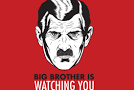
On each landing, opposite the lift-shaft, the poster with the enormous face gazed from the wall. It was one of those pictures which are so contrived that the eyes follow you about when you move. BIG BROTHER IS WATCHING YOU, the caption beneath it ran.
(I.1.3)

Twenty-first-century telescreens are computers of all kinds: desktop computers, laptops, mobile phones, tablets, video-game consoles, etc. Then, the internet is surrounded by malicious software (like spyware) capable of recording and tracking the activities performed by citizens all around the world. It usually seeks to satisfy the evil purposes described three paragraphs above and it generally involves huge amounts of money. Also, surveillance grows out of ignorance (people do not know about it) and greed (entire companies base their business on spying internet users and they earn high sums).

Every day the information grows as much as the population does, therefore, the databases generated out of massive surveillance will only become bigger and bigger:


With the increase in the sophistication and the reduction of the cost of bulk surveillance that has happened over the past ten years, we’re now at a stage where the human population is doubling every
twenty-five years or so—but the capacity of surveillance is doubling every eighteen months. The surveillance curve is dominating the population curve. There is no direct escape. We’re now at the stage
where just $10 million can buy you a unit to permanently store the mass intercepts of a medium sized country. So I wonder if we need an equivalent response. This really is a big threat to democracy and
to freedom all around the world that needs a response, like the threat of atomic war needed a mass response, to try and control it, while we still can.
(Assange 46-47)


As a conclusion, today's violation of privacy is as terrible as the one from 1984.


References:


Assange, Julian et al. "Cypherpunks: Freedom and the Future of the Internet." London: OR Books, 9 Jan. 2013. Print.

Greenwald, Glenn. "No Place to Hide: Edward Snowden, the NSA, and the U.S. Surveillance State." London: Penguin Books, 13 May. 2014. Print.

Lyon, David. “Surveillance, Snowden, and Big Data: Capacities, consequences, critique.” London: Big Data & Society, 4 Dec. 2014. Print.

- - -. "Fear, Surveillance, and Consumption." The Hedgehog Review Vol. 5, NO.3 (Fall 2003). Print.

Orwell, George. "1984 (Signet Classics)." United States: Signet Classic, 1 Jan. 1961. Print.

Peng, Kun. "Anonymous Communication Networks: Protecting Privacy on the Web." Boca Raton: Auerbach Publications, 7 Apr. 2014. Print.
 

This is my identity… It is, right?


In the last three decades, technology advances have certainly reshaped our society. One of the main authors who addressed the problems that people in the future would may face was Orwell. His dystopian society from 1984 warned some when the book was published, and others rejected his ideas since they thought he was too extremist. But, look at us now. Are we living in Orwell’s fictional society?
When talking about Orwell, another author that pops up is Hawthorne and his short piece of art “Wakefield”. Why? Well, these two authors questioned the human nature by pinpointing different aspects of humanity, and were able to warn us about one of the most frightening perils of dystopian societies: the loss of identity and manipulation of the system over citizens.
 If we analyzed their works, the protagonists of them may have more in common we us than what we think. Did you know that? The concept of identity in today’s society has become a fuzzy concept, and appareantly, we are dummed to live just as Winston and Wakefield did. 
1. 1984

Resultado de imagen para orwell
George Orwell
First, let us provide some context for 1984. Due to his work as a reporter, Orwell was one of those writers who had witnessed the worst atrocities the humankind can commit. Having gone to live among the extremely poor in England, moved to live with the destitute coal miners in northern England, and then travelled to Spain to experience by firsthand the nightmarish actions performed by fascist political regimes in the Spanish Civil War, he had plenty of information to write about and share with the world. However, it was the rise of Hitler and Stalin as power authorities in totalitarian political systems that ended up striking him the most and, consequently, inspired his well-known novel 1984, which nowadays seems to be one of the most explicit warnings someone could have ever given us about the perils of our technological advanced society.
By and large, 1984 depicts a Dystopian Totalitarian Society in which the world, in perpetual war, is divided in 3 big “countries”: Eurasia, Oceania and Eastasia. The story centers on the life of Winston, a citizen dwelling under a dictatorship in one of the provinces of Oceania. In his daily life, he is being constantly monitored by the Big Brother, the leader of the Inner Party, through a telescreen to identify traitors who do not follow the rules imposed by them or commit thoughtcrimes such as independent thinking, and, finally, make them disappear (in a few words they are killed).

Apart from complete surveillance, the Party makes use of several methods to maintain social control over the population. Some of them are language and education manipulation, terror, continuous sense of crisis regarding war, dehumanization of the opponent, and control of identity. The last one is the most terrifying since it is control of the citizen’s identities what keeps the Totalitarian System alive, and the idea of a Big Brother and the propaganda WAR IS PEACE FREEDOM IS SLAVERY IGNORANCE IS STRENGTH, accepted by many.

In Oceania every citizen has an assigned job, an assigned place to live, should dress in a certain way, and refer to others using the generic addressing word “comrade” because in this society they are all brothers. For instance, when Mrs. Parsons goes to his house, Winston expresses that “’Mrs’ was a word somewhat discountenanced by the Party—you were supposed to call everyone ‘comrade’— but with some women one used it instinctively” (Orwell, 2004, p. 26). By doing this, the rulers are making them fit into society with an invisible label on their chests that describe who they are, what they are allowed to do and, thus, how they must behave. For instance, Winston is a worker at the Fiction Department in the Ministry of Truth, which “concerned itself with news, entertainment, education, and the fine arts” (Orwell, 2003, p.7), and that is, supposedly, all.

Wittily, Winston’s job is to alter/distort past information provided to the citizens in newspapers, movies or propaganda so as to assure they match the Party’s current necessities in order to keep people’s faith and respect for the doctrines. In that way, memories are removed from their minds and reshaped by the existence of another different story. Evidently, as Winston knows that the Party uses this mechanism as a subordinating tool for them to preserve their power, this would suggest that he, unlike others, is aware enough to distinguish between his own identity and the one he was given.
According to Delia (2014), that Winston was familiar with the so-called brainwashing systems Memory Hotel and Newspeak, is not sufficient for him to wake up in this society. But, he needs to raise self-awareness too, which is the third aspect that contributes to the development of the characters’ identity. In her words, this “is not related to memory, but the will of the individual and the dare to indulge himself to think beyond the given barriers. With awareness comes a sense of identity.” (Delia, 2014, p.10).
However, how would he dare do that if he is being observed 24 hours a day, and the minimal attempt for rebellion would cost him his life? Several times in the story he highlights this point: “Always the eyes watching you and the voice enveloping you. Asleep or awake, working or eating, indoors or out of doors, in the bath or in bed—no escape. Nothing was your own (…)” (Orwell, 2003, p.37). Maybe, unconsciously, he tried to raise self-awareness when he risked buying both the diary and the glass globe, which are two elements that could revive memories, therefore, considered as sins and plagues that needed to be eliminated. Consequently, its possession in Oceania was forbidden and punished with death. We cannot say that he did not try, but in fact, he was not able to get out of the box he was placed in by the system; he did not even know why he had bought the diary and it was more difficult to decide what to write in it as his personal thoughts were already vanished.  
Then, in the end, constant change of collective memories led him to a sever identity crisis, and was now longer aware since his memories had faded. As stated by Ficeac (as cited in Delia (2014, p. 10), “the very idea of reality had been annihilated and replaced with the appearance of reality.” This is the reason why throughout the whole novel he has troubles remembering important facts about his childhood or the War, as exemplified in the following passage:
“(…) he was struggling, to think his way backward into the dim period of his early, childhood. It was extraordinarily difficult. Beyond the late fifties everything faded. When there were no external records that you could refer to, even the outline of your own life lost its sharpness. You remembered huge events which had quite probably not happened, you remembered the detail of incidents without being able to recapture their atmosphere, and there were long blank periods to which you could assign nothing.” (Orwell, 2003, p.40).


The Two Minutes Hate, is also an instance in which, through manipulation of data, images and the use of pathos, the system is able to alienate citizens and maintain their interests centralized. When this ceremony starts, Winston, in spite of not wanting to, cannot help but join in the vibrant audience shouting against Goldestein and worshiping the Big Brother through a self-hypnosis hymn:

“In the Two Minutes Hate he could not help sharing in the general delirium, but this sub-human chanting of ‘B-B!...B-B!’ always filled him with horror. Of course he chanted with the rest: it was impossible to do otherwise. To dissemble your feelings, to control your face, to do what everyone else was doing, was an instinctive reaction. But there was a space of a couple of seconds during which the expression of his eyes might conceivably have betrayed him.” (Orwell, 2003, p. 20)

To put if briefly, Winston in certain point to the accompaniment of Julia, experiences love interest, rebels against the system and is able to show in his notes in the diary, self-reflexivity. Nevertheless, at last, we are demonstrated the magnitude of the effects that manipulation from bigwigs can have on people’s individualism, when Winston once discovered of betrayal towards the Party, he suffers the consequences of his actions by being re-reshaped by the system so he can accept his alienations and is capable of denying one of the universal truths and his love for Julia.

 I recommend you watch the video below about the reasons why 1984 is still important. 


2. Wakefield

On the other hand, even though published many year before 1984, in “Wakefield”, Hawthorne develops the same idea of alienation and diminish of the self.
As it is usual in his works, Hawthorne tells us explicitly in the beginning of the story what this it is going to be about (even the title gives us a hint). Well, the story orbits around a man called Wakefield, who one day kissed his wife goodbye to go on ,at most, a week-long journey, but did not come home until 20 years had passed. Hawthorne ventures to explore the motives that may have driven Wakefield a man “with a cold but not depraved nor wandering heart, and a mind never feverish with riotous thoughts, nor perplexed with originality” (Hawthorne, 2012, p. 1) to abandon his duties as husband to move to an apartment near his old house and stay there undercover, however, still present observing his family’s life from the outside. It is curious that he had the guts to walk out of his house because Wakefield himself was not certain what he was going to the while standing there at the doorbell ready to leave. Once he decided to took some time to be on his own, his original plan was to spend a couple of days in the rented room, however after the months began to pass by, every time he considered the idea of going back home he postponed his return.
At the end, Wakefield goes back home as he realized his expectations were not fulfilled; he had expected his beloved one to suffer from his lost and their lives to change because of that. In fact, that was one of the reasons why he went away but stood close enough to observe (a voyeuristic action) his family, he wanted to see what life would look like without him there. But, his expectations were not fulfilled as they eventually continued living normally, and, what is more, as years passed, not even his wife was able to recognize him on the street:
“The sober widow, resuming her former pace, proceeds to church, but pauses in the portal, and throws a perplexed glance along the street. She passes in, however, opening her prayer-book as she goes. And the man! with so wild a face that busy and selfish London stands to gaze after him, he hurries to his lodgings, bolts the door, and throws himself upon the bed.” (Hawthorne, 2012, p. 5)
This scene was the event that motivated Wakefield to abandon his loneliness and return to his house because he notices that “individuals are so nicely adjusted to a system, and systems to one another and to a whole, that, by stepping aside for a moment, a man exposes himself to a fearful risk of losing his place forever.” (Hawthorne, 2012, p. 6). For him, more days absent would have meant his vaporization as a person. Although he was already vaporized/disappeared for his family, he still thought that he owned a room in the world, but he discovered that if we are not immersed in the system, we do not have an identity as this self we are is determined by the system, and consequently, if there is no identity, there is no person.


Strikingly, we may draw the conclusion that the main argument for leaving his house was that he needed to find himself; he needed to get the custom of the caring husband that society had make him try on; he needed to be away from the system to find his identity, but it appeared that he stepped out, he lost it instead. In the following passage, for example, having spent several years living alone, he realizes the consequences of being self-deprived of the system’s rules.

“He was in the bustle of the city, as of old; but the crowd swept by and saw him not; he was, we may figuratively say, always beside his wife and at his hearth, yet must never feel the warmth of the one nor the affection of the other. It was Wakefield's unprecedented fate to retain his original share of human sympathies, and to be still involved in human interests, while he had lost his reciprocal influence on them.”

It is undoubtedly true that Hawthorne expressed himself as an alienated artist through his writing of Wakefield. Wineapple (2003) adds that “even as he castigates Wakefield, Hawthorne colludes with him, relishing an ordinary man’s extraordinary caprice” (p. 86). She states that by giving Wakefield the possibility to escape from his ordinary life, Hawthorne extends his longing for a life and world that would not oppress the selves of all of us, but liberates us.

3. Loss of Identity

Now, does it sound familiar to you the fact that we are who we are based on the label that the system has given us? Certainly, Orwell predicted our current problems in society, but Hawthorne as well did. However, something that not all may notice is that, yes, we cannot escape from the system because living in it determines us as persons, so, if our identity is what the system wants it to be, then, we have lost our self too, which implies we cannot discover our real self. This is exactly what happens in the two stories, by being fitted in society, they end up turning down the opportunity to achieve originality and individuality by being rewarded with social comfort.

For this reason, have you thought for a minute “Who am really I?” Have you had the feeling you want to escape from your reality? Have you felt tired of letting others judge who you are by the pictures you post on Facebook? By the number of likes you get?
Personally, I think that, nowadays, with all these social networks such as Facebook, Instagram, Twitter and others, we worry more about what the rest can say about us, how we are going to be labeled according to social standards of beauty, wealth, health, intelligence, etc. As a result, we put on masks to show someone who we are not. The system requires us to, or otherwise, we will be socially excluded.

Delia (2014), notes that in 1984, “the state has successfully created a state where citizens are more object than human.” and she extends this thought to the 21st century, by stating that we have become object that “have no choice but to adhere to exterior will, similar to how an object can only be moved by an exterior force”.
Many scholars, agree that Orwell’s 1984 is a cautionary warning that can save us from losing ourselves as a society. What do you think? Do you feel yourself right now? Do you think there is still hope for us?


References
Delia, M. (2014). The Political Role of Memory and Identity in Dystopian Societies. European Journal of Research and Reflection in Arts and Humanities, 2(2), pp. 7-17.
Hawthorne, N. (----) Wakefield, Retrieved from: http://www.accuracyproject.org/t-Hawthorne-Wakefield.html
Orwell, G. (2003). Nineteen Eighty Four. St. Ives: Penguin Books
Wineapple, B. (2003) Hawthorne: A Life. NY: Knopf. 


a fight against the system


“Bartleby the scrivener” by Herman Melville (1953) , and 1984 by George Orwell (1949) are two well known classics that, even though,  written 100 years apart from each other, placed in different countries and continents, and showing totally different scenarios , share some characteristics of society, such as  inequality, social isolation, and social and individual roles in a system that wants to control everything. These characteristics  can be analyzed and compared to reach a conclusion about the main concerns of the authors in a dystopian world, in which everything is imperfect and everything goes terribly wrong.
By means of this, I will start by giving a little summary of both stories as to contextualize the information that will be compared ahead. Secondly,  I will give the historical context of both stories to show how the development of those events could have lead the authors to produce such important pieces of work. Thirdly, I will compare the information gathered to reach conclusion.


First of all, “Bartleby the scrivener” tells the story of an unambitious Wall Street lawyer that decides to hire a fourth clerk to relieve the load of work of his law firm.  A man called Bartleby takes the job and after days of successful and dutiful job, decides not to work anymore, refusing any duty with the words “I would prefer not to”. However, he also refuses to quit his job, to be fired, and to leave the workplace, turning into an unwanted and eccentric guest.


1984 is a dystopian novel that takes place in a post-apocalyptic Era in which  the Earth has been divided among 3 nations which are constantly on war with each other. The novel  follows the story  of a man  named Winston who lives in London in the nation of Oceania. He is a low-ranking member of the ruling Party leadered by a political figure known only as Big Brother, and feels frustrated by the oppression and rigid control of the Party. These nations, more especially Oceania, is characterized by its power for  controlling everything that their citizens do, for the use of propaganda to brainwash their citizens, for the use of devices to oppress their populations,  the criminalization of thoughts, and for the invention and implementation of a  language, called Newspeak, that aims to prevent future rebellions.


Secondly,  In his essay about modernism Childs (2000) explains that Modernist texts often focus on social, spiritual or personal collapse, all of these characteristics are present in these dystopian stories, and showcase their plot since they are set in  a time when social relations are almost lost because of the capitalist, and totalitarianism voragine. “Bartleby the scrivener” was written in an era in which the world was being reshaped by means of countless important historical events that happened only a few years before and after its publication. Namely, the Industrial revolutions in Europe, which created an economic gap in the world economy that has been impossible to close until today,  the rise of some colonies against the empires because they didn’t want to be ruled by them anymore, the 1840 to 1850 labour riots because of class warfare in New York, and the worldwide spread of capitalism among others events.


On the other hand, 1984 was written in a time in which society was facing the beginning of the Cold War, a time in which the world was absolutely polarized, people didn’t trust on each other,  and  some countries were really impoverished after the end of the World War II. Some countries enjoyed their freedom while others were tyrannized under totalitarian regimes that kept and iron fist on its citizens, who had little or no freedom, and that were forced to work, were poor, hungry, and living under the constant menace of mass execution, an allegedly common procedure in those regimes.


Both stories highlight the conditions in which the working class lived in those times.  The working class was so impoverished after all the global events that had happened, not to mention because the minimal wage didn’t exist yet,  that they worked not to live, but to survive. Meanwhile, the upper class enjoyed their extravagant luxuries and lifestyle, something that we can also relate with to today’s society. The following quote of Bartleby the scrivener mentions how Turkey, one of the scriveners wasn’t able to even afford new clothes, even though, he worked on a law firm.


The truth was, I suppose, that a man of so small an income, could not afford to sport such a lustrous face and a lustrous coat at one and the same time. As Nippers once observed, Turkey’s money went chiefly for red ink. (Melville, 2003:4)


Therefore, office workers like Bartleby, Nuts, Turkey, and Nippers had to  live in practical poverty because people in the position of authority, in this case their boss, the lawyer, didn’t take into account to real needs of his workers. Moreover, 1984 also mentions the impoverished look and aesthetics of the working class.


He moved over to the window: a smallish, frail
       figure, the meagerness of his body merely emphasized by the blue
         overalls (Melville, 2003:2)


Their society presents a dichotomy in their living conditions. The head of the Party, the Inner party, lived with luxury, with servants at their disposition, and in beautiful apartments, while the the Party members, who were the majority,  lived in single room apartments located in rickety places. Even their food was tasteless and of low quality. These dreary, decrepit and dark scenes of poverty are a fine example of dystopia in both stories.


Another comparison between the two books is that it is full with class alienation, and the social roles of the characters are uneven. In “Bartleby the scrivener” the lawyer separate himself physically  from his workers by putting screens to divide his space and their space, that way he didn’t need to look at them while they worked, yet, this simple act of .


I should have stated before that ground glass folding-doors divided my premises into two parts, one of which was occupied by my scriveners, the other by myself. According to my humor I threw open these doors, or closed them (Melville, 2003:6)


Moreover, in 1984 characters also show class alienation, however, the relation made in that book is far more explicit, since in that story,  people from the same social class  are allowed to share among them  and they are obligued to use the same colours and clothes to give them a sense of hegemony, but, they are not allowed to mix with someone from a lower social class  Party members were supposed not to go into ordinary shops ("dealing on the free market," it was called) (Orwell, 1984:1.1.13)


These facts are very important to understand that this story is not just about an eccentric scrivener who refused to work or to leave his work place after being fired, and it is not just about a man who decided to face a totalitarian regime, but it is also about the uneven  relation and opportunities, that existed and that still exists, among social classes.


It is also important to pinpoint  that both novels mention the annulation of individuality. In “Bartleby the scrivener” all the office workers have a mold imposed by the society, their is to work all day without complaint, drink some liquor after work, and going home. in 1984 is the same, each social class has its own mold to which adhere, they must act, think, and dress as they were told without discussion, they didn’t have independence or individuality and no one could be unique. However, Winston yearns to be different after so many years of being just another brick in the wall, so he decides to face this mold imposed by the system. I think that these are metaphor of a common social behaviour,  our society tends to base other people's identity according to their profession or occupation, it seems that it is impossible for us to separate both things since we are what the system has imposed us. Those who do not fit it the mold imposed by the society are obliged to change or else they will be replaced. That was the case with with Bartleby, he didn’t fit anywhere inside the mold, didn’t want to do what the other workers did since he was there only to copy, not to make errands, so he was removed. Both characters fight against losing their identity,  but they also deal with how that identity affects they place in society.  .


REFERENCES


Childs, Peter. Modernism. London: Routleage, 2000
Orwell, G. (1983). 1984. New York: Plume.
Melville, H. (2003). Bartleby the scrivener =. Paris: Gallimard.